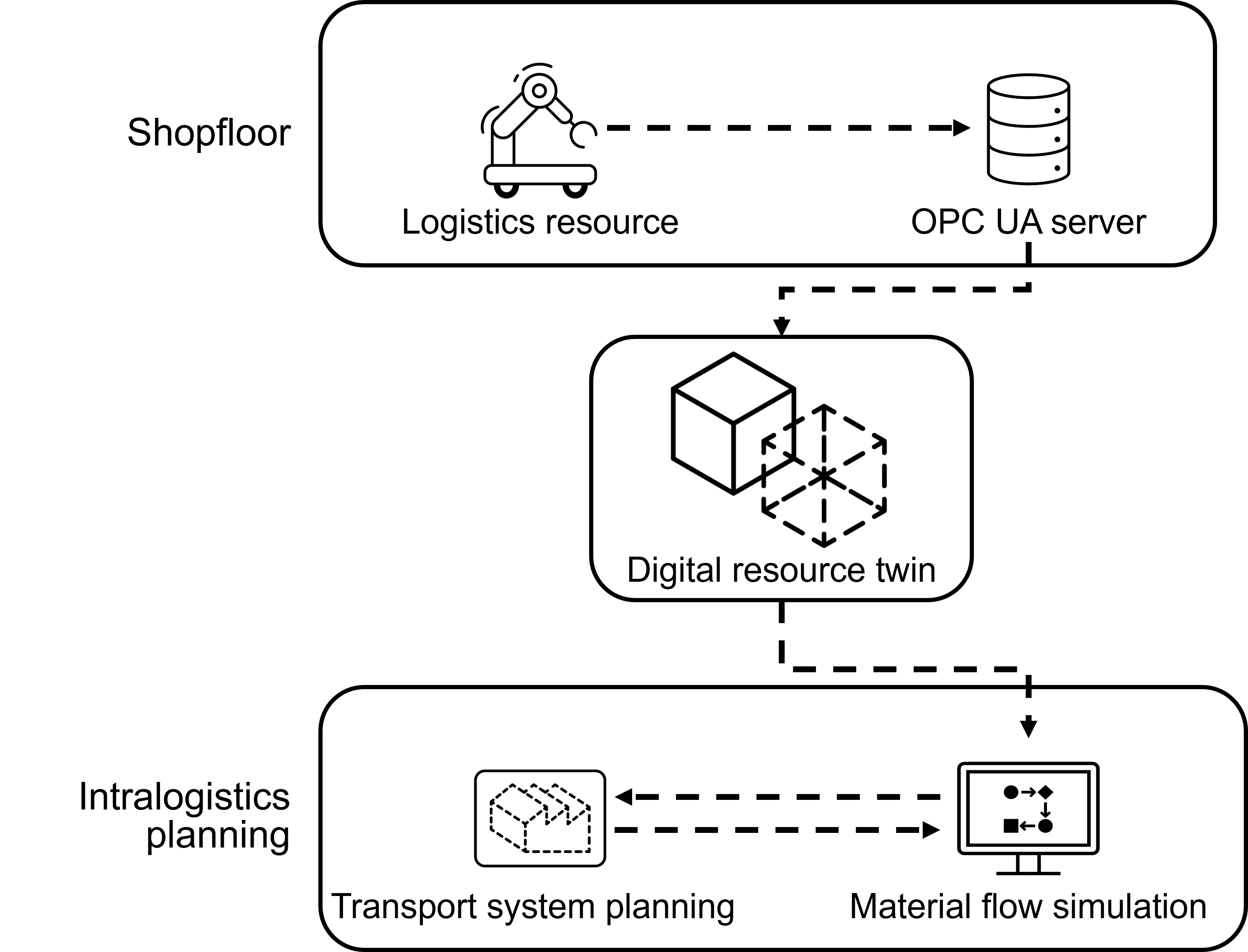
Digital Resource Twin Connects the Shop Floor and Planning
The DiMoLo project is developing a Digital Resource Twin (DRZ) to serve as a seamless data bridge between real-world logistics resources and intralogistics planning. Operational data from the shop floor is collected via appropriate interfaces, structured, and made available for simulation, transport planning, and material flow analysis. This allows planning assumptions to be compared with real-world performance data and enables more accurate sizing of future systems.
Designing Mobile Manipulators to Be Cost-Effective and Robust
A key focus is on the data-driven evaluation of mobile manipulators in assembly and logistics environments. This approach supports the selection of suitable resources, the identification of bottlenecks, and the assessment of technical and economic impacts. Virtual and physical demonstrators show how new planning methods can be translated into a level of maturity suitable for real-world applications.
From Data Model to the Factory of the Future
By integrating Industrial IoT, simulation, and digital factory planning, a robust information flow is created for future production systems. This enables companies to evaluate logistics areas, transport racks, automated guided vehicles, and robotic handling more realistically.
Project Objectives and Expected Results
The project’s objectives include determining material requirements, designing various but bondable and printable multi-materials, the production of powder material for prototypes, the optimization of AM process parameters, the development of design guidelines for multi-material components, the validation of system-designed multi-materials, the development of recycling methods, and the reduction of the carbon footprint.
Validation in Industrial Use Cases
The project also aims to validate five use cases in the automotive, aerospace, and aeronautics sectors. The use cases are expected to achieve a weight reduction of more than 50%, a 20% reduction in development time for multi-material products, and an increase in product performance of at least 30%.
 Fraunhofer Institute for Casting, Composite and Processing Technology IGCV